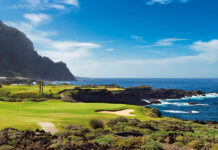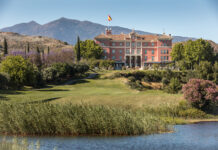

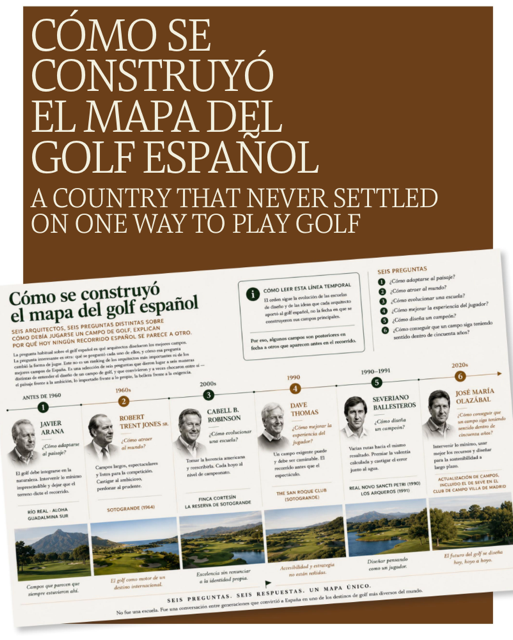


The usual question about golf course architects in Spain is which of them designed the best courses. The more interesting question is what each of them was actually asking, and how that question changed the way the game is played here. This isn’t a ranking of the country’s greatest architects, or its greatest courses. It’s a selection of six questions that produced six different ways of thinking about course design: ideas that coexisted, and occasionally clashed, landscape against ambition, imported thinking against homegrown instinct, beauty against demand.

Let the land decide: Javier Arana
Long before Spanish golf gave any thought to the international traveller, Javier Arana was already building courses that responded to the land beneath them. His rule was close to a self-imposed limit: eighty percent of a course had to stay exactly as the land presented it, with only twenty percent left open to human intervention. He moved as little earth as the design allowed, stayed away from water hazards, and favoured wide greens angled across the line of play, with few bunkers, each one placed with purpose. The result, still visible at Río Real, Aloha and Guadalmina Sur, is a course that doesn’t look designed at all. It looks like it was simply always there.
While Arana was proving that a course could respond to its landscape, tourism was already asking for a different scale altogether.

Inventing a destination, not just a course: Robert Trent Jones Sr.
When Robert Trent Jones Sr. arrived in Spain in the mid-1960s, the country barely registered on golf’s international map. The Sotogrande course, known today as Real Club de Golf Sotogrande, was his first in Europe. It opened in 1964 and changed that almost overnight. Trent Jones built courses that were long, visually dramatic, and ready to host serious competition, and he had a phrase for the philosophy behind them: hard par, easy bogey, a course should punish the ambitious and forgive the cautious. That formula coincided, not by chance, with the moment the Costa del Sol was establishing itself as a golf destination: a coastline with mild weather year-round and an international luxury tourism trade already in place, conditions that go some way to explaining why so much of Spain’s golf-tourism map ended up drawn there too. Trent Jones didn’t just design courses. He helped invent a destination.
The generation that followed didn’t reject that school. It rewrote it from the inside.

Inheriting a school, then rewriting it: Cabell B. Robinson
Cabell B. Robinson spent twenty years working alongside Robert Trent Jones, seventeen of them running the firm’s European office and overseeing every course the practice built in Europe during that period. Nobody understood the American school better than he did. When he went independent, though, he didn’t repeat it. He rewrote it. Robinson has never kept count of how many courses carry his name, because to him golf architecture sits closer to art than science: what mattered was never the tally, but that not a single hole fell below championship standard, a demand as present at Finca Cortesín, host of the 2023 Solheim Cup, as at La Reserva de Sotogrande. He learned the American grammar, and used it to write different sentences.
While Robinson was rewriting the American school from within, a different tradition, British this time, was making its own case a few miles down the coast.

The course before the spectacle: Dave Thomas
Dave Thomas asked a question nobody else had taken seriously: can a demanding course still be walked? The Welshman, runner-up twice at The Open Championship, in 1958 and 1966, before turning to design, understood architecture through the player’s experience rather than the aerial photograph. His courses never sacrifice strategic demand, but nor do they impose it at the ordinary golfer’s expense. The San Roque Club, his best-known work, still ranks among Spain’s best courses today without ever compromising its walkability. In the same corner of Cádiz, he also designed Almenara, now known as The Alto Club, which opened in 1998. It was proof that accessibility could be its own form of excellence.
Americans and British alike, they were all still thinking about Spanish golf from the outside. What was still missing was the country’s own first voice.

Golf course architects find their Spanish voice: Severiano Ballesteros
Severiano Ballesteros was, arguably, the first of Spain’s golf course architects to design the way a tournament player thinks, rather than the way a course engineer draws. His courses rarely force a single route to the green. There are almost always several routes to the same outcome, rewarding calculated boldness and punishing mistakes made too close to the water. In 1990 he signed his first course in Spain, Real Novo Sancti Petri, in Cádiz; a year later came Los Arqueros, in Benahavís, just outside Marbella, routed to follow the natural fall of the land and give every hole its own character. With those two courses, Ballesteros proved Spanish golf could finally speak in a voice of its own.
The map these Spanish golf course architects built still defines much of the golf played in Spain today. But there’s a question none of them had to answer yet.

Sustainability as strategy: José María Olazábal
Olazábal began designing with the same player’s authority as Seve, but he’s working through a question the previous generation never had to face: how long is this meant to last? As he puts it himself: intervene as little as possible in the landscape, and build with long-term sustainability in mind, from materials to water use. It isn’t an environmental gesture. It’s a calculation about the future. That thinking is clearest today in his renovation work, including, tellingly, Seve’s own design at Club de Campo Villa de Madrid, which Olazábal is now adapting so it stays playable fifty years from now. If Spain’s map is already drawn, Olazábal is the one asking how to make it last.
Spain never settled on a single school of design, and that’s probably its greatest asset. Where other countries built their identity around one idea of how golf should be played, here, very different philosophies coexisted, and still produce courses that feel unmistakably their own. To travel Spain’s golf map, in the end, is to encounter six different golf course architects, each imagining the same game differently.
Frequently asked questions
Who are the most important Spanish golf course architects?
Six names define the country’s golf map: Javier Arana, Robert Trent Jones Sr., Cabell B. Robinson, Dave Thomas, Severiano Ballesteros and José María Olazábal, each working from a different design philosophy.
Which course did Robert Trent Jones Sr. design first in Spain?
Real Club de Golf Sotogrande, which opened in 1964 as his first course in Europe.
What courses did Severiano Ballesteros design?
His first was Real Novo Sancti Petri in Cádiz (1990), followed a year later by Los Arqueros in Benahavís.