

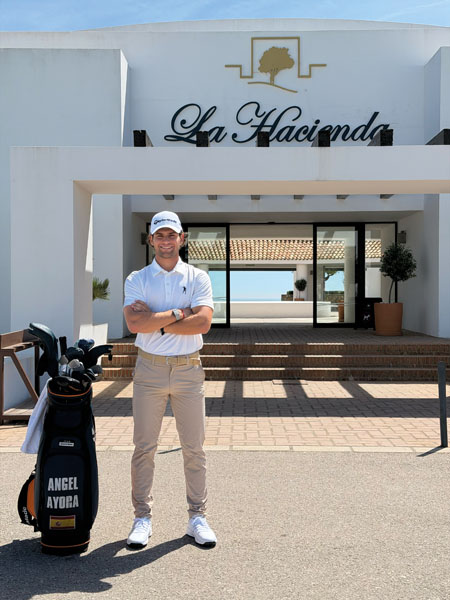


In today’s game, talking about the future is often a convenient way of avoiding the present. With Ángel Ayora, the opposite is true. At just 21, he is already moving comfortably within the DP World Tour — backed not only by results (ten top-10 finishes in his rookie season), but by something less tangible: a growing sense on tour that his ceiling is still some way off.
In that context, Golf Circus brings together Ayora, his coach Juan Ochoa, and the team at La Hacienda Links Golf Resort — general manager Javier Jiménez-Casquet and Director of Golf Fernando Padrón — to look beyond the results and understand what is really driving that progression.
His talent is not in question. Nor is his ability to compete in demanding conditions. But in a sport where the gap between contending and winning is minimal, the next step rarely comes down to one thing.
Behind that progression lies more than a good swing. There is now a clear structure to his work: physical preparation, recovery, mental performance — a broader approach that treats the player as a complete athlete.
“The standard keeps rising, and improving in every area is non-negotiable if you want to reach the top,” says Ayora.
Within that framework, Juan Ochoa — coach, caddie and one of the most respected figures in Spanish golf — has played a defining role. His view is simple: talent might open the door, but it does not take you through it.
“If you want to be a top player in the world today, you have to make a difference in every small detail.”
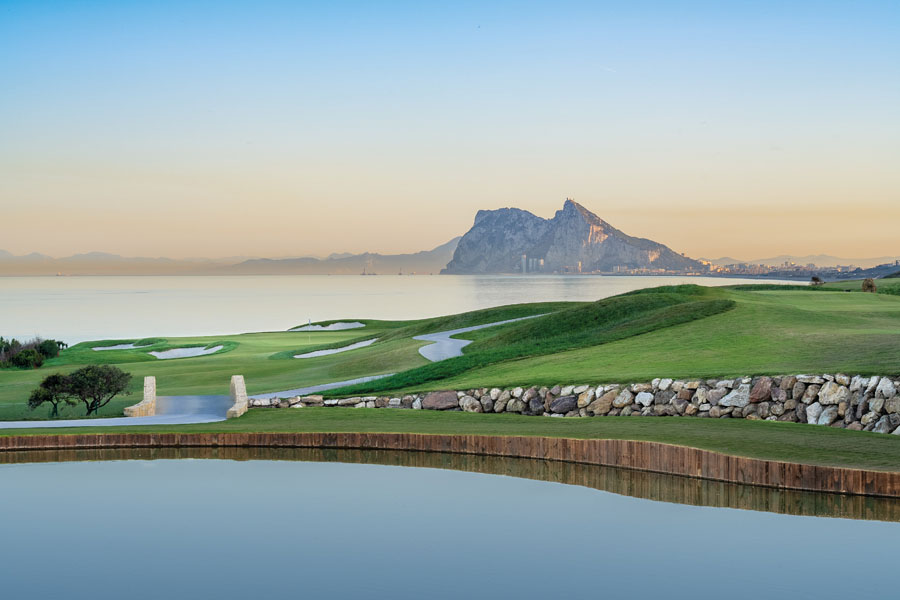
Much of that work takes place at La Hacienda Links Golf Resort, where Ayora trains regularly. It is an environment that does more than provide world-class conditions — it exposes him to the kind of situations he will face on tour: wind, shot-making variety, and greens that punish any lack of precision.
It is no coincidence. It is part of a process with a clear aim: turning potential into performance.
Ángel Ayora: the game from within
Ayora shows little interest in the noise around him. Asked whether he sees himself as one of the standout talents in Spanish golf, his answer is immediate: “It’s not something I pay much attention to.”
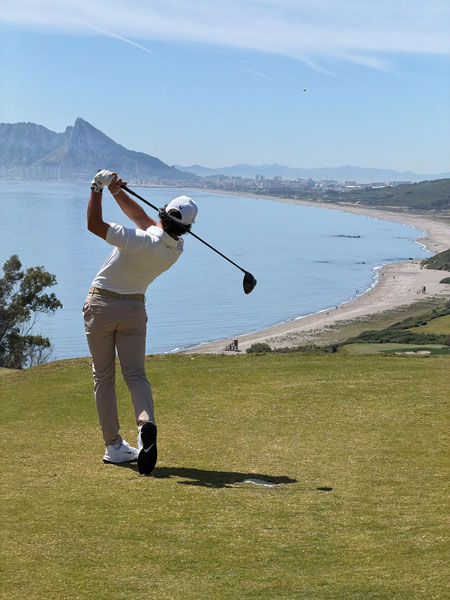
That detachment contrasts with how he is viewed inside the game. His name comes up more and more often — not just for the results, but for the way he is building his game.
His swing is the obvious starting point. Fluid, efficient, almost effortless, it has become one of his defining traits. But Ayora is quick to put it into context.
“If you’ve got a good swing, people expect the ball-striking to follow — but there are plenty of other things that matter more.”
Because at this level, technique alone is not enough. The areas that matter most are often less visible.
“Last year, my short game and putting were the weakest parts, but we’ve improved a lot over the last few months.”
That clarity — knowing exactly where the next gains lie — is part of the process. So is the way he approaches this early stage of his career.
It is not just about playing more, but about exposing himself to different conditions and learning what works.
“At the start of your career, it’s important to play all kinds of courses, see different places and understand which ones suit you best.”
That thinking explains a busy schedule, but also a clear objective.
“My goal is to earn a PGA Tour card. For that, you need points — and the more you play, the more chances you have.”
Away from the course, the structure continues. Physical work, analysis, attention to detail — elements that were once secondary are now part of the foundation.
“Golf is a very demanding sport and the level keeps rising. You have to improve in every area if you want to get to the top.”
This is not a short-term shift. It is an adaptation to what the modern game demands — and a sign that Ayora has already moved beyond potential into something more concrete.
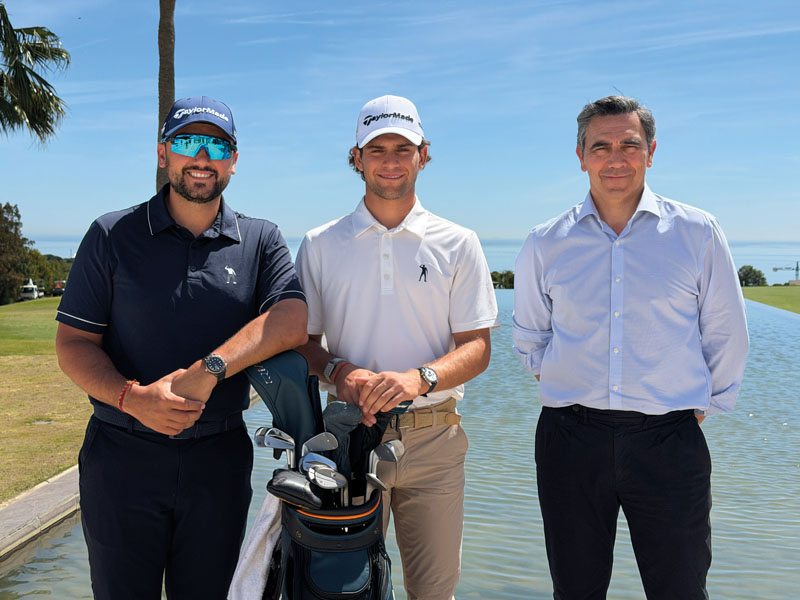
Juan Ochoa: shaping the talent
If anyone can translate Ayora’s potential into something tangible, it is Juan Ochoa. His perspective is grounded, analytical, and focused on what still needs to be built.
When asked about the expectation surrounding the player, he does not hesitate.
“The hype is very real. He’s shown more than enough to suggest he can win any tournament he enters.”
But that belief comes with context. The step from competing to winning remains.
That is where the work lies.
Technically, Ochoa highlights the efficiency of Ayora’s swing — one of the most striking aspects of his game.
“It’s a very efficient motion, both in impact control and speed generation. He’s among the longest hitters, and it looks effortless.”
That base keeps him competitive even when he is not at his best. But, as Ochoa points out, it is only part of the picture.
“A good swing helps, but it guarantees nothing.”
The next gains are more specific.
“He needs to sharpen his putting and, above all, be clearer on the course and trust himself more.”
Because at this level, execution and decision-making are inseparable.
Ochoa’s view goes further. Player development, in his eyes, is no longer just technical.
“To be a top player today, you have to make a difference in every detail you can control.”
And that requires a shift in mindset.
“You have to see the player as an elite athlete — not just someone who plays good golf.”
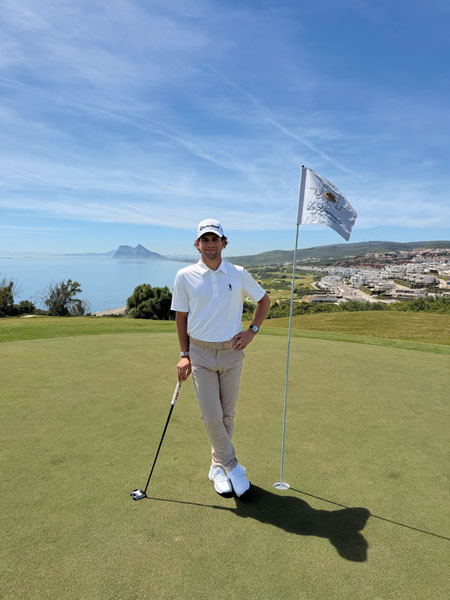
The course: Ángel’s perspective
Ayora’s development is shaped as much by his environment as by his work. In that sense, La Hacienda Links Golf Resort is not just a base — it is part of the process.
Links it is not a forgiving course. It demands adaptation. And at this level, that matters.
“It’s a course where you have to hit every type of shot and use every club in your bag.”
That variety becomes a tool. Each situation forces a decision; each shot a different read — and that is what translates into performance.
The greens are a defining feature.
“They have a lot of movement, and you have to be very precise if you want to leave it close.”
“The most iconic hole on the Links course is the 5th— the views are incredible — but I’d say my favourite is the 16th, a par 5. It’s very demanding from the tee and forces you to be precise with your next shot, especially if you go for the green, as it’s quite narrow.”
“As for the Heathland course, I tend to play it when the wind is coming from the west. It’s very competitive, and my favourite hole there is the 10th — another par 5 that you need to think your way around, as it can catch you out if you’re not careful.”
Ochoa adds two key factors: the greens themselves and the wind.
“They’re more undulating and quicker than they look, and the wind is always a factor here.”
Together, they turn practice into real preparation.
Because at this level, execution alone is not enough. Adaptation is everything.
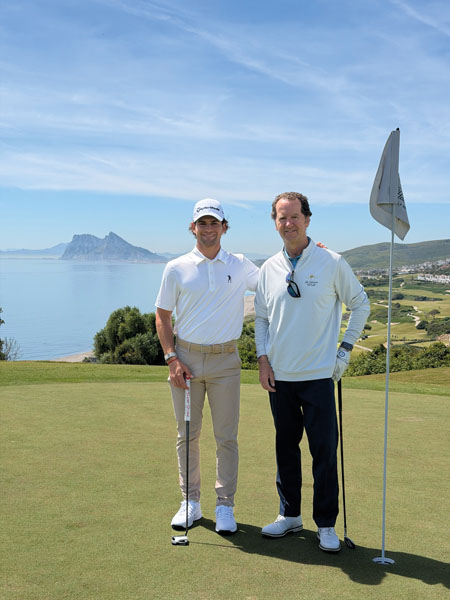
La Hacienda Links Golf Resort: part of the process
Ayora’s environment extends beyond the course. There is a structure behind it — one that supports without interfering.
At La Hacienda Links Golf Resort, that approach is deliberate.
“It’s a real source of pride that a player like Ángel has chosen us as his training base.”
The connection began early — and has grown with his career.
“From the start, we saw his commitment, his attitude, his professionalism. It felt natural for him to be part of the club.”
That continuity matters. It turns the club into more than a base — it becomes part of his routine.
From a technical standpoint, Director of Golf Fernando Padrón focuses on how the course supports that work.
“The short-game areas allow you to practise every type of shot in conditions that are very close to competition.”
The design of the surfaces and the variety of playing conditions are intentional.
“We’ve created different types of greens and surfaces to help players adapt to different scenarios.”
For the team at La Hacienda, it is not just about hosting a professional player.
It is about being part of his development.
And that is where the environment stops being a setting — and becomes part of the process.